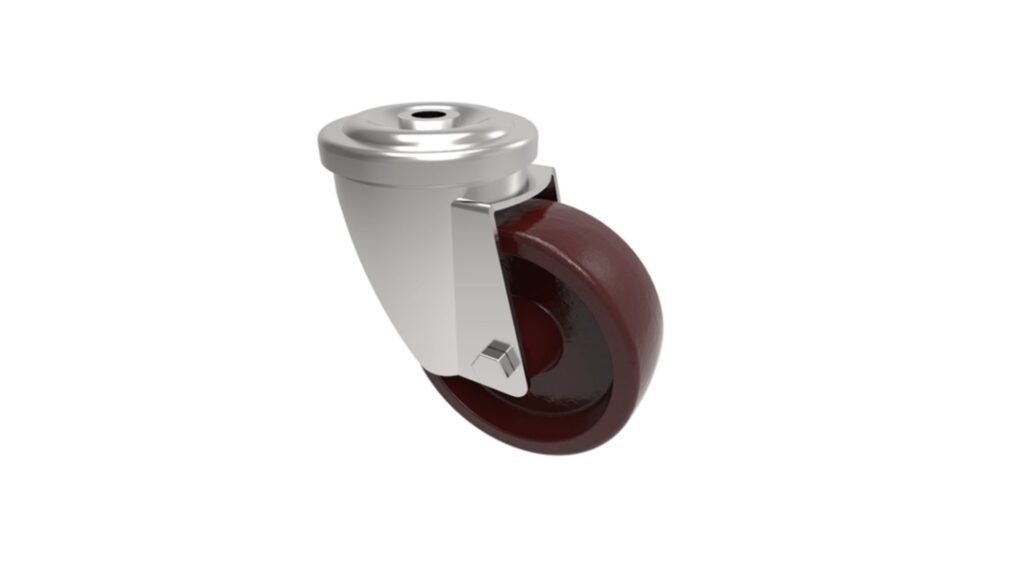
Stainless steel castors cost more than zinc plated ones, sometimes considerably more. In the right environment they last years longer and are the only sensible choice. In the wrong one they are money spent on corrosion resistance you will never use.
Here is how to tell which situation you are in.
Four conditions, any one of which makes the case:
Food production, commercial kitchens, breweries, dairies and pharmaceutical manufacturing all wash equipment down under pressure, often with caustic or acidic cleaners. A zinc plated castor in that environment corrodes at the plating breaks, water gets into the bearings and the swivel seizes. Six to twelve months is a common life expectancy, and by then the equipment is difficult to move and looks poor.
Laundries, wet rooms, car washes, fish processing and swimming pool plant rooms will corrode plated castors even without aggressive chemicals. Standing humidity is enough.
Coastal sites, harbour equipment, marine and offshore applications. Salt is unforgiving and gets everywhere, and marine grade stainless is worth specifying over standard grades here.
Sometimes the driver is not corrosion but compliance. Stainless housings can be cleaned and inspected properly, and smooth open designs with fewer dirt traps are far easier to satisfy an auditor with.
Dry indoor environments. Warehouses, workshops, offices, retail, general manufacturing, dry storage. If the equipment is not washed down, does not live in standing moisture and is not near salt, a good quality zinc plated castor will last as long as you need it to and costs a fraction of the price.
Specifying stainless for a dry warehouse trolley is not a safety margin, it is just a higher invoice.
This is the single most important point in this article.
A castor is a system, not just a housing. It contains a kingpin, ball races or roller bearings, a wheel centre, a brake mechanism and a set of fixings. If the housing is stainless but the bearings and kingpin are plated steel, water and cleaning chemicals will reach them, corrode them and seize the swivel. You will have paid for stainless and got a castor that fails in much the same time as a plated one.
When specifying for a washdown environment, confirm all of the following are corrosion resistant:
Sealed or shrouded swivel heads are worth the extra in high pressure washdown, because the seal is what actually keeps water out of the race.
Standard stainless grades handle general moisture and most food environments comfortably. Where chlorides are present, from salt, seawater or certain cleaning chemicals, a higher marine grade resists pitting corrosion far better. If your site washes down with chlorinated products or sits on the coast, mention it when you order, because it changes the recommendation.
| Tread | Suits | Notes |
| Grey non marking rubber | Healthcare, food areas, finished floors | Quiet, floor friendly, lower load capacity |
| Polyurethane | Heavier loads on resin and tiled floors | Good all rounder, check chemical compatibility |
| Nylon | Wet areas, chemical exposure, high static loads | Hard on floors and noisy |
| Polypropylene | Light duty wet areas | Inexpensive, limited load capacity |
| Stainless steel wheel | Extreme heat combined with washdown | For ovens and autoclaves, will mark floors |
The comparison people should run is not purchase price, it is cost per year of service. A plated castor replaced twice a year in a washdown bay, with the labour to change it and the equipment out of service while you do, will cost more over three years than a properly specified stainless castor bought once.
The exception is genuinely light duty equipment in a mildly damp environment, where a cheap castor replaced occasionally can work out fine. Be honest about which situation you are in.
Corrosion resistant rather than rust proof. Stainless resists corrosion far better than plated steel, but the grade has to suit the environment, particularly where chlorides are present.
In almost all washdown areas, yes, and full stainless construction rather than just a stainless housing. Dry ambient storage areas within a food business may not need it.
Zinc plating is a coating over steel that eventually breaks down or gets damaged. Stainless steel resists corrosion throughout the material, so a scratch does not start a rust patch.
Yes. Heavy duty fabricated stainless ranges are available for applications that combine serious load with washdown or marine conditions.
Standard stainless castors are not high temperature rated. Where heat and washdown occur together, such as in bakeries and autoclave areas, specify high temperature stainless steel castors, which pair stainless construction with heat resistant wheels and bearings.
The most useful thing you can tell us is not the load, it is the cleaning regime. How often, at what pressure, at what temperature and with what chemicals. Give our UK team that and we will specify a castor that lasts. Supplying British industry since 1979, with guarantees of up to 10 years.


