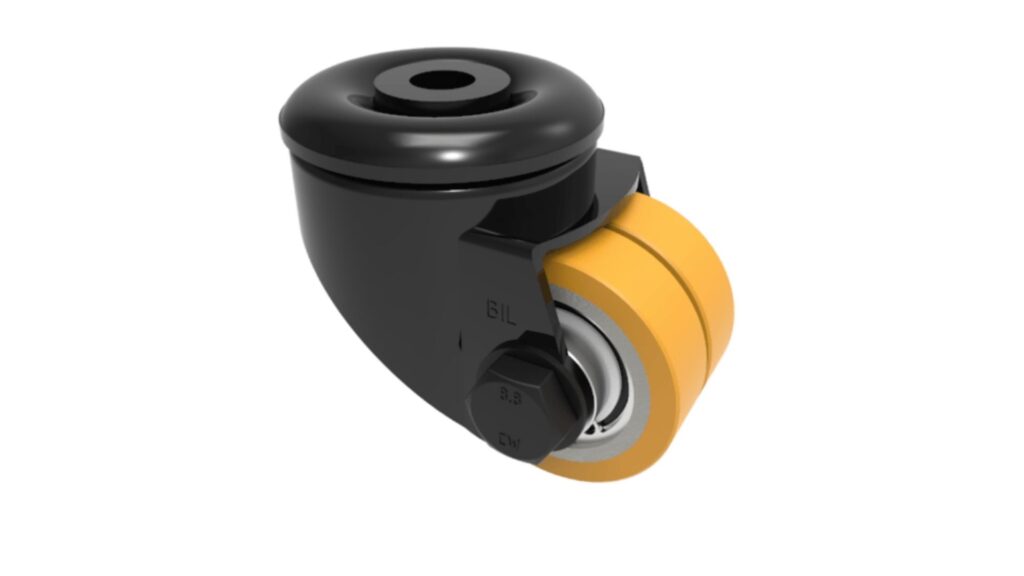
Low profile castors, also called low level castors, solve a specific problem: you need to make something mobile and there is almost no room underneath it. Overall heights start from around 45mm, with wheels as small as 35mm, and load ratings are considerably higher than the size suggests.
The catch is that small wheels are far less forgiving than large ones, and understanding why saves a lot of wasted money.
A 35mm castor sounds like something for a light display unit, but many low profile units carry well over 100kg each. That is because the housings are compact and rigid, the wheels are wide relative to their diameter, and there is very little leverage acting on the swivel head.
So load capacity is usually not the limiting factor. Floor condition is.
A wheel can only climb an obstacle up to roughly a quarter to a third of its radius before it stops being a rolling problem and starts being a lifting problem. On a 35mm wheel, that is a very small number.
In practice this means:
Low profile castors belong on smooth, level, clean surfaces. Put them on a workshop floor with joints and swarf and they will disappoint, however good the specification looks on paper.
| Application | Why they suit |
| Under drawer and cabinet units | Keeps unit height unchanged when retrofitting |
| Machine bases and skid frames | Adds mobility with minimal lift |
| Display plinths and retail fixtures | Hidden from view, smooth shop floors |
| Server and AV cabinets | Machine room floors are flat and clean |
| Low profile dollies and skates | Deck height is the whole point |
| Theatre trucks and rostra | Keeps the deck as close to stage level as possible |
Three measurements, and you need all three before ordering:
The mistake here is measuring the wheel and assuming the castor will fit. A 35mm wheel in a 50mm overall height housing needs 50mm of clearance, not 35mm.
The terms low profile and low level are used interchangeably in the industry and mean the same thing. Neither is a formal specification, so always check the actual overall height rather than relying on the description.
If you need to go lower still than any castor will allow, a skate or a machine mover is the next step. These use multiple small rollers in a very shallow frame and can get under equipment with almost no clearance at all, though they only travel in a straight line unless steered.
This is worth saying plainly. If you have 70mm or 80mm of clearance available, use it. A 75mm wheel will roll over floor imperfections that stop a 35mm wheel completely, needs noticeably less push force, and costs about the same.
Only go as small as the clearance genuinely forces you to. The number of low profile castors sold to solve a problem that a slightly taller castor would have solved better is considerable.
Wheels from around 35mm, with fitted overall heights from roughly 45mm depending on the housing and fixing type.
Considerably more than the size suggests, often over 100kg per castor. Check the specific rating and calculate on three castors rather than four to allow for uneven floors.
Yes, the terms are used interchangeably. Always check the stated overall height rather than the description.
No. Small wheels sink into pile and the push force becomes impractical. You need a larger diameter wheel for carpet.
Yes, and they are commonly used where a retrofit must not change the height of the piece. Check the fixing type matches what the furniture will accept.
Tell our UK team the clearance you have to work with and the weight you need to carry, and we will tell you what fits and whether a slightly larger wheel would serve you better. Supplying British industry since 1979, with guarantees of up to 10 years.


