Fitting a castor is straightforward once you know which of the four fixing types you are dealing with. Removing an old one is often the harder half of the job, particularly on furniture where the stem has been in place for years.
This guide covers both. If you have not yet identified what you need to order, read our guide to measuring and replacing castors first, then come back here.
Look at how the castor attaches to the equipment. It will be one of these:
| Fixing type | How to recognise it | Common on |
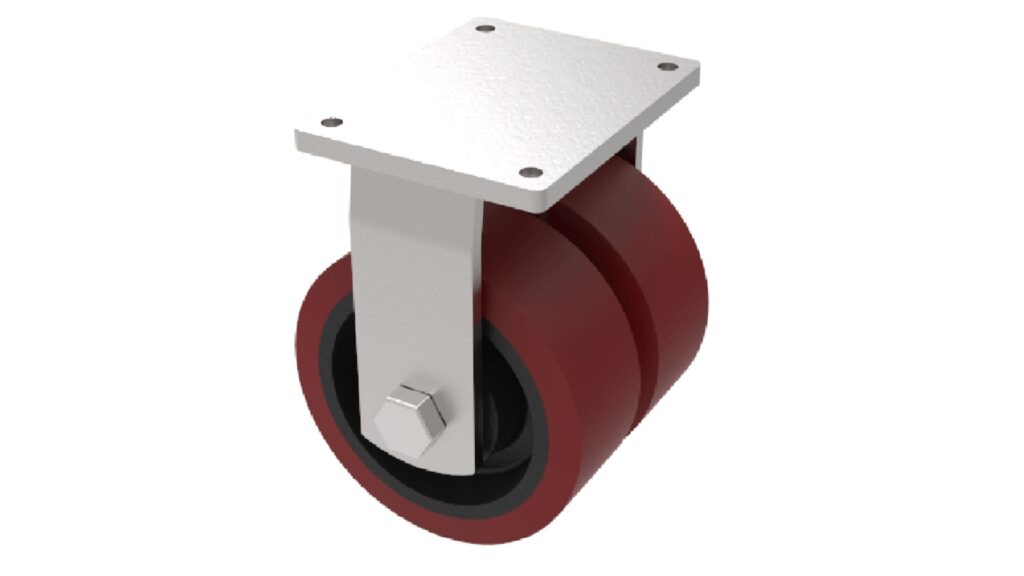
| Top plate | Flat square or rectangular plate with four bolt holes | Trolleys, industrial equipment, cabinets |
| Threaded stem | Bolt style stem screwing into a threaded insert | Furniture, catering equipment, medical trolleys |
| Grip ring stem | Plain round stem with a sprung ring, pushes into a socket | Office chairs, light furniture |
| Expander | Stem with a rubber or nylon sleeve that expands inside a tube | Tubular frames, display units |
These are not interchangeable. A castor bought with the wrong fixing cannot be adapted without an adaptor plate or a replacement stem.
Support the equipment on blocks so the weight is off the castor, then undo the four bolts. If the bolts are seized, penetrating oil and a few minutes of patience will usually do it. Take one of the old bolts with you when buying replacements, since thread sizes vary.
Grip the stem itself rather than the housing, because turning the housing just spins the swivel head. Mole grips on the flat of the stem, or an adjustable spanner if there is a hex section, then unscrew anticlockwise. Penetrating oil first if it has been in place for years.
These pull straight out, but they are held firmly by the sprung ring. Lever it out with a flat bar or a screwdriver blade under the housing, working evenly around the base rather than pulling from one side. Protect the furniture surface with a cloth or a block of wood. A steady increasing pull works better than sharp yanking, which tends to snap the socket.
Slacken the central bolt, which releases the pressure on the sleeve, then the whole unit pulls out of the tube. If it will not release, the sleeve has usually bonded to the inside of the tube. Tap the bolt head gently to push the cone back before trying again.
This is the most common sticking point, especially on older furniture.
Position the plate and mark the holes if you are drilling fresh. Use all four bolts, not two, since the load and the swivel forces are shared across the plate. Check the bolt length so it engages fully without protruding into the equipment. Nyloc nuts or thread lock are worth using on anything that rolls, since vibration loosens plain nuts over time.
Screw in by hand first to confirm the thread engages cleanly. If it binds in the first turn or two, stop, because you have almost certainly got the wrong thread size and are about to strip the insert. Tighten fully so the housing seats flat against the surface, but do not overtighten and crush the fitting.
Line the stem up square with the socket and push firmly straight in until the ring clicks past the lip. A sharp push with the heel of your hand usually seats it. Do not tap it in at an angle, which bends the stem.
Push the expander fully into the tube, then tighten the central bolt progressively. The sleeve expands against the bore as you tighten. Check for movement by twisting the castor before putting the equipment back on the floor.
It depends on the fitting. Grip ring stems lever out, threaded stems unscrew, and expanders release when the central bolt is slackened. Penetrating oil and patience solve most stuck fittings.
Yes, provided there is enough flat surface to take the plate. You may need a mounting plate or an adaptor to spread the fixing across sound material.
Yes, in almost all cases. Castors from different ranges vary in overall height by a few millimetres, which makes the equipment rock and puts uneven load on each castor.
Fixed castors go at the end you push from, swivel at the far end. That gives you a trolley that tracks straight and still steers.
Yes. Even a small difference in overall height means one castor carries no weight, which makes the equipment unstable and overloads the other three.
Send our UK team a photograph and a measurement and we will tell you what you have got and what replaces it. We have been doing this since 1979, and everything we supply carries guarantees of up to 10 years.


